


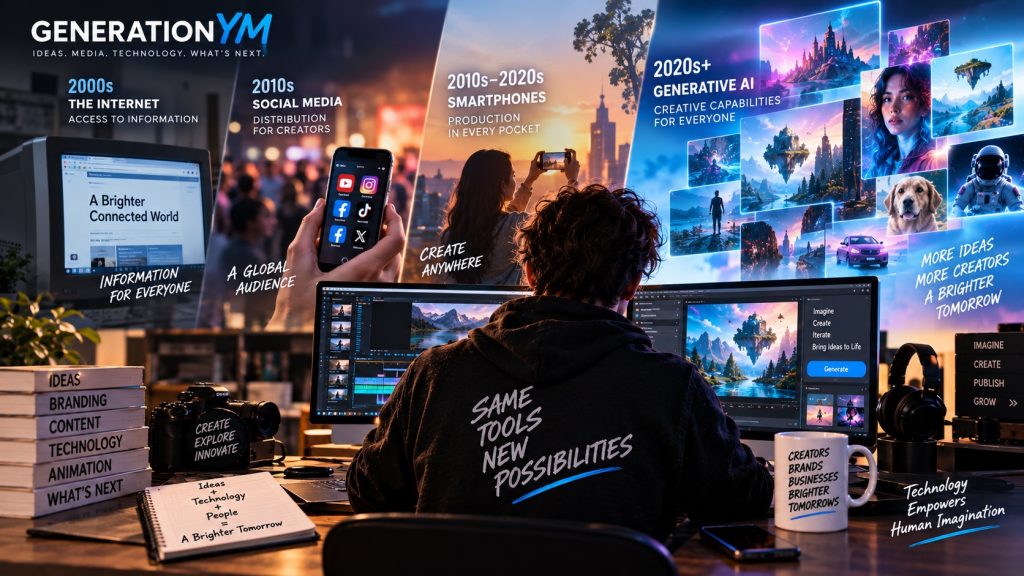
Every major shift in digital media changes who can create, what they can create, and how quickly an idea can reach an audience.
The internet changed access to information.
Social media changed distribution.
Smartphones put cameras, editing tools, and publishing platforms into billions of pockets.
Now generative AI is beginning to change the creative process itself.
Images, video, audio, visual effects, concepts, and other forms of digital media can increasingly be created, modified, and explored through AI-powered tools.
For creators and businesses, this is more than another software upgrade.
It represents the next stage in a much larger evolution of digital creation.
Social Media Changed Who Could Reach an Audience
Before social media, reaching a large audience usually required access to someone else's distribution.
Television networks controlled television audiences. Radio stations controlled radio audiences. Newspapers and magazines controlled print distribution. Record labels, publishers, studios, and other media companies acted as gatekeepers between creators and consumers.
The internet began breaking down those barriers.
Social platforms accelerated the process.
Suddenly, an individual creator could publish directly to millions of people.
YouTube allowed anyone with a camera to operate something resembling a personal television channel.
Facebook and Twitter changed how information moved between people.
Instagram transformed photography and visual identity into forms of everyday communication.
Later, TikTok and short-form video demonstrated just how quickly an individual idea could move around the world.
The biggest change was not simply technological.
Distribution had been democratized.
Creators Became Their Own Media Companies
Once creators could reach audiences directly, something else began to happen.
The line between an individual and a media company started to disappear.
A single person could develop a brand, produce content, build an audience, attract advertisers, launch products, sell services, collaborate with other creators, and distribute everything through channels they controlled.
At GenerationYM, we have watched that transformation unfold from the early days of new media.
Creators who were once simply building YouTube channels or social followings began developing recognizable brands and digital businesses around those audiences.
Companies experienced a similar transformation.
A business no longer needed to rely entirely on advertising agencies or traditional media outlets to communicate with customers.
Every company could become a publisher.
Every brand could create media.
Every person with an audience could potentially build an enterprise around it.
That changed the economics of digital media.
Smartphones Changed Who Could Produce
Social media democratized distribution, but production still required tools.
Over time, those tools became dramatically more accessible.
Professional cameras became smaller and less expensive.
Editing software moved from specialized production environments onto personal computers.
Then smartphones combined cameras, editing tools, internet connectivity, and global distribution into a single device.
A creator could record a video, edit it, publish it, communicate with an audience, and analyze the response without ever sitting at a traditional production workstation.
The technical barrier between having an idea and publishing that idea became smaller.
That helped create an entirely new generation of independent digital creators.
Generative AI Is Changing the Next Part of the Equation
Generative AI is pushing that evolution further.
Social media made distribution accessible.
Smartphones made production more accessible.
AI is making creative capabilities themselves more accessible.
A person does not necessarily need to be an illustrator to explore a visual concept.
A small team can experiment with video ideas that once would have required significantly more production resources.
Images can be transformed, extended, or reimagined.
Audio can be generated and manipulated.
Visual ideas can be tested before a traditional production begins.
Concepts that previously existed only in someone's imagination can increasingly be turned into something visible within minutes.
The result is a shorter distance between an idea and its execution.
How We Use the Next Generation of Creative Tools
At GenerationYM, we've spent years working with emerging forms of digital media, technology, branding, content, and online platforms.
Today, we use PixyDust as part of that evolution, bringing AI-powered video, image, audio, and other creative capabilities into the creative process.
What makes this generation of tools interesting isn't simply that individual tasks can be completed faster.
It's that capabilities that once existed across specialized software, production teams, and separate workflows are beginning to converge.
An idea might begin as a written concept.
That concept can become an image.
The image can inspire a video.
Audio can change the mood.
Different versions can be explored before deciding which direction deserves further development.
Having those capabilities available within a more unified creative environment makes experimentation easier.
For us, that is where AI becomes particularly useful.
It gives creators and businesses a much shorter path from an idea to something they can actually see, test, refine, and publish.
The Creative Process Is Becoming More Iterative
Traditional production often forces creative decisions to happen early.
When every variation requires additional photography, design, editing, animation, or production resources, experimentation can become expensive.
That naturally limits the number of ideas a team can explore.
Generative AI changes some of those economics.
Instead of committing immediately to one creative direction, a team can explore several.
A concept can be tested visually before production begins.
Different styles can be compared.
A campaign idea can be developed through multiple visual treatments.
A creator can discover that the third or fourth version of an idea is significantly better than the first.
This makes iteration a larger part of the creative process.
And that matters because the first idea is not always the best idea.
Small Teams Can Operate With Greater Creative Leverage
Digital technology has repeatedly allowed smaller teams to accomplish things that once required much larger organizations.
AI is likely to accelerate that trend.
A small business may not have separate teams for design, video, audio, animation, copy, concept development, and post-production.
An independent creator may be responsible for nearly all of those functions.
AI-assisted tools can help those teams move across disciplines more easily.
That does not mean every creator suddenly becomes an expert designer, filmmaker, animator, or musician.
Specialized talent still matters.
But creators can now explore ideas outside their primary skill set before deciding where deeper expertise is required.
That creates leverage.
And throughout the history of digital media, leverage has been one of the biggest forces behind new forms of entrepreneurship.
Businesses Are Becoming Creative Organizations
The same transformation is happening inside businesses.
Modern companies are expected to produce an enormous amount of media.
Websites need imagery.
Social platforms need videos.
Advertising campaigns need creative variations.
Product launches need demonstrations, graphics, landing pages, email campaigns, and promotional content.
Customers increasingly encounter a company through media before they ever speak to someone inside the organization.
That means creative production is no longer something reserved for entertainment companies and advertising agencies.
It has become part of everyday business infrastructure.
AI can make that infrastructure faster and more flexible.
More Content Is Not Necessarily Better Content
There is an obvious consequence to making content easier to produce.
There will be more of it.
A lot more.
When images, videos, audio, and written material can be produced at dramatically greater speed, simply creating content becomes less of a competitive advantage.
Attention becomes even more valuable.
That shifts the challenge.
The question is no longer simply whether you can create something.
It is whether anyone cares about what you created.
Brands will still need ideas.
Creators will still need personalities.
Stories will still need a reason to exist.
Businesses will still need to understand their customers.
Technology can accelerate production, but it does not eliminate the need for strategy, taste, judgment, and originality.
The Value of an Idea May Actually Increase
When production is difficult, technical execution itself can be scarce.
When production becomes easier, good ideas become the scarce resource.
Imagine a world where almost anyone can generate a polished image.
The image itself is no longer unusual.
What matters is the concept behind it.
The same will increasingly apply to video.
If cinematic-looking footage becomes easy to generate, simply producing something cinematic will not guarantee attention.
The idea, story, humor, perspective, timing, and creative direction become more important.
In that sense, increasingly powerful AI could make human creative judgment more valuable rather than less.
New Technology Creates New Forms of Media
One of the most interesting things about technological change is that the most important uses are rarely obvious at the beginning.
Early internet video often imitated television.
Early social media often resembled personal websites and blogs.
Early smartphone photography attempted to reproduce what people already did with cameras.
Eventually, each technology developed its own creative language.
YouTube produced entirely new entertainment formats.
Instagram changed visual culture.
TikTok helped establish a different style of short-form storytelling.
Creators discovered formats that were native to the technology rather than simply recreating older media through new tools.
Generative AI is still early enough that the same process is happening now.
Some of the most interesting AI-native forms of media may not have been invented yet.
From Search Box to Creative Interface
For much of the internet's history, software required people to learn how the software worked.
You learned menus.
You learned interfaces.
You learned specialized tools.
Generative AI introduces a different relationship between people and computers.
Increasingly, people can describe what they want.
The interface begins to look less like operating software and more like communicating an intention.
That shift has enormous implications for creative technology.
If the barrier to using sophisticated tools continues to fall, many more people will be able to participate in forms of digital creation that previously required specialized knowledge.
The creative population gets larger.
The Next Generation of Creators Will Expect AI
Every generation of creators treats the technology available to them as normal.
There was a time when publishing a video to millions of potential viewers from a bedroom would have sounded extraordinary.
Today, it is routine.
There was a time when filming, editing, distributing, and analyzing a piece of media from a phone would have required an entire collection of specialized tools.
Today, teenagers do it every day.
The next generation of creators may view generative AI the same way.
Generating a visual, transforming an image, creating a video concept, experimenting with audio, or collaborating with an AI system may simply become normal parts of the creative process.
They may not think of it as "AI content."
They may simply think of it as creating.
The Next Evolution Is Already Underway
Digital media has never stopped evolving.
Each generation of technology lowers one barrier and creates a new set of possibilities.
The internet opened access.
Social media opened distribution.
Smartphones opened production.
Generative AI is opening creative capability.
What happens next will depend less on whether the technology becomes powerful enough.
It will depend on what creators, entrepreneurs, and businesses decide to do with that power.
The tools will continue to improve.
The workflows will become faster.
The boundaries between different forms of media will continue to blur.
And more people will gain the ability to turn an idea into something the rest of the world can see.
That is not the end of digital creation.
It is the beginning of its next generation.
Respond